

Overload and adaptation - the basic principle of training
7/15/2026 8:47:00 AM
Effective training requires specificity, consistency, and progressive overload. This creates fatigue, but proper recovery timing allows the body to adapt and reach supercompensation.
Author: Franz Studer
First things first - Specificity and consistency
Training is a planned, repeated stimulus (exercise sessions) designed to create a predictable change in the body’s ability to perform. Improvements are strongest when training is specific to the goal (e.g., strength training improves strength; endurance training improves aerobic fitness) and when it is applied consistently over time rather than in occasional, isolated sessions.
Following a training plan means following a pre-determined course of action(s) over a prolonged period of time. More on that subject will be discussed in later article covering the basic principles of periodization.
Overload
Overload means the training stimulus must be greater than what the body is currently used to, otherwise there is little reason for the body to change. Overload can be applied by increasing one or more variables such as intensity (heavier/faster), duration (longer sessions), volume (more sets/reps/kilometres), density (less rest), frequency (more sessions per week), or complexity (more demanding skills). Effective overload is progressive and controlled—too little produces no adaptation, too much increases fatigue and injury/illness risk.
Adaptation
Adaptation is the body’s response to training stress: it repairs damage, restores energy stores, and upgrades systems (muscles, tendons, cardiovascular capacity, neuromuscular coordination) so the same workload becomes easier in future. A useful way to think about adaptation is the fitness–fatigue relationship: training creates fatigue immediately (performance dips), while fitness improves more slowly. When recovery is adequate, fatigue drops and fitness remains—so performance rebounds and can temporarily rise above baseline (supercompensation).
Recovery is when adaptation happens
Recovery is when adaptation actually happens. If you train again too soon, you stack fatigue on fatigue and performance can trend downward (higher injury risk, poorer quality sessions). If you wait too long, you may miss the peak of supercompensation and progress slows. The “right” recovery window depends on intensity, duration/volume, the muscle groups involved, sleep, nutrition, stress, and training age.
Supercompensation and the timing of recovery
The supercompensation curve describes how the body responds after a training session: first, performance temporarily drops because the workout creates fatigue and uses up energy stores; then, during recovery, the body repairs tissue, restores fuel, and adapts to better handle the same stress in future; if recovery is sufficient, performance rises above the original baseline for a short period—this is the supercompensation phase. The key training principle is timing: training again too soon can add fatigue before adaptation is complete, while waiting too long may allow the benefit to fade, so progress is best achieved by applying the next appropriate training stimulus near the peak of recovery. Intensity and duration of a session are the two factors that influence the time required to reach the peak of recovery, and also how far above baseline fitness this peak lays, as shown in the illustration below.
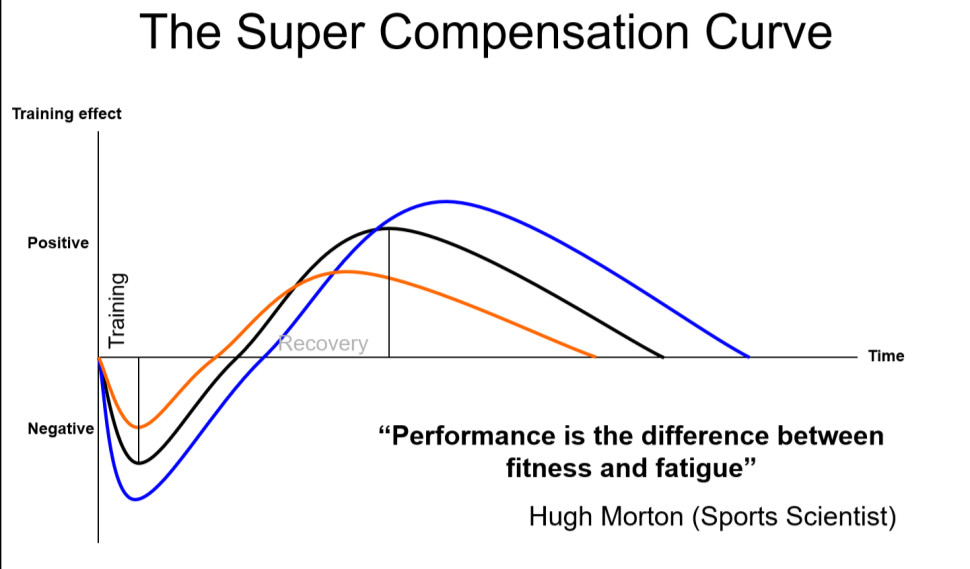
Fatigue dominates
Training session (stress) causes a temporary dip
Immediately after recovery train again near peak
How recovery time varies with intensity and duration
The ranges in the table below are general guidelines. Individual recovery varies by training age, sleep, nutrition, stress, and previous workload. Practical signs you are ready to repeat a hard session include restored performance in warm-up, normal soreness levels, good sleep, and stable resting heart rate/energy.
| Session type (example) | Intensity / duration | Typical recovery before a similar hard session* | Why |
| Easy aerobic / technique | Low intensity, short–moderate duration | ~0–24 hours | Low muscle damage and nervous system stress; mainly replenishes fluids/glycogen. |
| Steady moderate endurance | Moderate intensity, moderate–long duration | ~24–48 hours | Greater glycogen depletion and overall fatigue; needs sleep and nutrition to restore. |
| High-intensity intervals / speed work | High intensity, usually short–moderate duration | ~24–72 hours | High nervous system and metabolic stress; legs may feel “flat” until fatigue clears. |
| Heavy strength (compound lifts) | High intensity, moderate volume | ~48–96 hours (muscle-group dependent) | More muscle damage and connective-tissue stress; recovery depends on total volume and experience. |
| Very long endurance (e.g., long run/ride) | Low–moderate intensity, very long duration | ~48–120+ hours | Large glycogen depletion plus musculoskeletal wear; recovery scales strongly with duration. |

Founded in 1946 by the Missionary Sisters, Assumption Convent is an independent Catholic girls schools in the heart of Johannesburg offering affordable, quality education.
AFFILIATIONS



OUR BROTHER SCHOOL

People also search for: private schools johannesburg ; private girls schools johannesburg ; girls schools johannesburg ; catholic schools johannesburg ; independent schools johannesburg ; catholic girls school ; best schools in gauteng south africa ; private christian schools ; best private schools in gauteng ; affordable private schools in johannesburg ; affordable private schools in gauteng ; preprimary schools johannesburg ; preschools johannesburg ; private primary schools johannesburg ; private primary schools ; primary schools in gauteng south africa ; christian primary schools ; affordable high schools in johannesburg ; high schools in johannesburg ; catholic high schools ; private high school ; aftercare schools ; after school programs
© 2025 by Assumption Convent School | Protection of Personal Information Policy | PAIA Manual
Assumption Convent School - Academic Scholarship Application

Each year Assumption Convent School offers a limited number of Open Academic Scholarships to female students entering Grade 8. Assumption Convent School would like to offer current Grade 7 girls an opportunity to apply for this prestigious scholarship for 2027. Scholarships will be awarded to female students entering Grade 8, who excel academically. This scholarship is open to Grade 7 Assumption Convent School students as well.